Bali Part 1 – Nyepi and Ogoh-ogoh Day

And now for Bali. The Eat Pray Love section of the blog is here. I know you’re looking forward to it.

We spent the first 6 days of our Balinese adventure in a town on the southern coast called Sanur. Sanur was the first tourist area developed in Bali, and its kind of fun to see kitschy tourist stuff from the ‘60s and ‘70s. Its like if the Brady Bunch went to Bali. See??

We stayed in an apartment on the northern side of Sanur, and while in theory it was a 5-minute walk to the beach, that walk involved crossing a freeway and getting chased by scabby dogs. Jeff nearly got physical with a weenie dog. So yes… we were a bit less than impressed with Sanur. On the plus side, however, we did get to experience an interesting neighborhood and spend time on the locals beach, which was so much more appealing than the Aussie poop-party in the fancier parts of southern Bali.

Unbeknownst to us, our visit coincided with the Balinese New Year festival of Nyepi, which was really a treat. There are three basic parts to the Nyepi festival: 1) the multi-day preparation phase, 2) Ogoh-ogoh day (which is Nyepi-eve), and 3) Nyepi day itself.

Based on what I can piece together from observations and some surprisingly specific but unhelpful Wikipedia articles, the preparation for Nyepi involves several (4-ish?) days of sitting on the beach while wearing pretty white clothes and praying. Each day people bring small offerings of food and flowers to send out to the sea, and a holy man does some incredibly creepy chanting. Not to get all E-P-L, but I was impressed by how seriously people take the preparations for Nyepi – praying, preparing nice little offerings, and sprinkling things with baggies of holy water seems like a full-time job.

For Parts 2 and 3 of the Nyepi holiday we headed north to the town of the quiet town of Pemutaren (much more on this delightful town later). As far as I’m concerned Ogoh-ogoh day is really the star of the Nyepi festival. Village youth groups get together and build the Ogoh-ogoh’s –giant papier-mâché and Styrofoam demons that are freaky and surprisingly lewd. Here are a few of my favorites:

On Ogoh-ogoh day these demons are paraded through town by the village children. At each road intersection the Ogoh-Ogohs are spun around 3 times counter-clockwise to disorient the evil Ogoh-Ogoh spirits and thereby keep the village safe in the coming new year. Multiple people told me that the evil spirits are tricked into going to the nearby island of Java, so that’s fun and neighborly.

Once the Ogoh-ogoh demons are thoroughly disoriented , the procession continues to the beach. The Ogoh-ogohs are then set on fire, much to the delight of the screaming teenagers who made them. It’s really quite the spectacle. American holidays need to be more like this.

After the chaotic revelry of Ogoh-ogoh day comes Nyepi, the final day of the festival. Nyepi is an island-wide day of silence and rest – no going outside, no electricity or lights, and no doing anything fun. The airport closes down, and there are scary religious police who make sure you adhere. By keeping the island quiet and dark for a day, the fleeing spirits of the Ogoh-ogohs are ‘tricked’ into thinking the island is uninhabited, and leave Bali alone of another year. We were staying at a wonderful small resort run by a German couple, so we could leave our bungalow but not the resort grounds.

This was our Nyepi prison – somehow we survived.

Next up, I’ll tell you all about how great Pemuteran is and I won’t mention anything about E-P-L or Balinese religious life. I promise. (But maybe I will since we’re going to Ubud.)

Malaysia Part 2 – Ipoh and Penang

In 2016, Lonely Planet ranked the Malaysian city of Ipoh as one of Asia’s top 10 destinations. There are countless breathless descriptions of Ipoh as a ‘foodie heaven’ and ‘foodie town’, so not unreasonably, we thought that Ipoh might be a nice place to break our train trip from Kuala Lumpur to Penang. After a short 2-hour train ride from KL, we arrived in Ipoh excited to eat!

Now, I don’t mean to say that Ipoh sucks – in fact we had quite enjoyed it – but when one’s entire reason to visit a place is based on food, one expects to, you know, find some food. We could not find food!!!! I don’t mean ‘good food’; I just mean ‘food’. Full stop. Ipoh seemed abandoned, and there were like no restaurants open. Two of the acclaimed hawker centers we attempted to visit were completely closed. True, we were in town mid-week, but it was indescribably odd. I’m honestly perplexed as to why our experience of Ipoh was so contrary to general consensus.

But if the food was the low light, the highlight was our accommodation. We did a homestay in a lovingly restored guesthouse on Concubine Lane, and our host was a Brit from Wigan named John. John was a real character, and peppered conversations with gems like ‘chinaman’ and ‘jap’. He had three cats named Ginger, Tiffy, and Smokey who made our stay a real treat. I think that Tiffy was my fave, partially because ‘Tiffy’ is just so fun to say and partially because she had a less obvious flea infestation.

Ipoh was tin mining boom-town during the 19th century, and there are some surprisingly good and interesting museums dedicated to the tin industry. We got a great guided-tour from Auntie Christie at the Han Chin Pet Soo museum, which was an old club house for the Hakka mining community. Look how cute we are in our Hakka hats!!! I felt racist doing this…

Our host John arranged for us to visit some extra-city tourist sites with Mr. Low, a delightful gentleman who owns a small shop next-door to John’s house. Until 3 months ago Mr. Low’s shop was a mahjongg den, but his clientele base had some infighting issues so the mahjongg had to stop. Now he sells candy and water to tourists like us. Despite being 72 years old, Mr. Low is a devotee of a FarmVille knockoff called ‘Hay Day’, and he frankly seemed quite good at it. Taking a break from his virtual harvests, Mr. Low was a great tour guide for us and we definitely got a taste of the area with him as a guide. We visited the Guharu tea plantation, the supposedly haunted Kellie’s Castle (scary!!!), and a few cave temples.

Later on, we got to enjoy an evening at the neighborhood bar with John and Mr. Low. Run by a Sinhalese family, the bar is simply called ‘The Sinhalese Bar’ and the moment you step through the saloon doors you’re transported to pre-WWII Malaya. Established in 1931, it’s run by Albert, a 70+ Ipoh native who is the original founder’s son. (side-bar: this place had the refrigerator of my dreams. It was a half-sized ~1940’s kelly green Singer refrigerator that I would kill a man for. I’ll never forget that refrigerator.) We spent the evening watching Tamil music videos, and enjoying a concoction John calls the ‘black and white’, which is a Guinness mixed with a Tiger beer. What an evening.

After a memorable visit to Ipoh, we took the train north to Penang. We were delighted to get to meet up with Andrea and Michael again, and enjoyed relaxing and eating (properly!) in Penang’s historic Georgetown. Georgetown is a UNESCO World Heritage site and was a major economic hub during Malaysia’s colonial days. It’s just adorable, and filled with historic Chinese shop houses, Indian mosques, and lots of interesting European buildings. We explored the charming alleyways of the old town, and visited the newly restored ‘La Maison Blue’, a fabulous mansion build by the Chinese tycoon Cheong Fatt Tze. Andrea and Michael took way better pictures than us so you should look at their photos.

Overall we had a lovely and very uneventful visit, with the exception of some genuinely frightening encounters with monkeys at the botanical gardens. Travel pro-tip: monkeys really like Nutty Buddys, so be careful.

And thus concludes our 2 part Malaysian epic. Off to Indonesia!

Malaysia Part 1 – Kuala Lumpur and Putrajaya

After the relatively chilly weather in Hong Kong, Kuala Lumpur embraced us like a hot stinky-sticky blanket. Our Uber driver from the airport to our hostel was a really nice young guy just finishing up a master’s degree in environmental science. Just two weeks prior, one of his Uber-driver pals had inadvertently served as the get away driver for one of Kim Jong Nam’s assassins and spent 2 days in police custody. Man, KLIA2 (as the airport is called) has some bad luck.

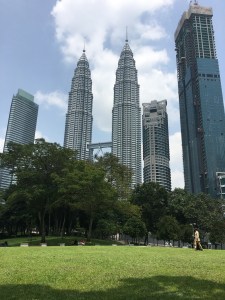
Since I’d spent a few months in KL 4 years ago, I was super excited to show Jeff my old stompin’ grounds. It turns out that Jeff was super not excited for this, and accusations of ‘death marches’ were made. Perhaps fairly. Kuala Lumpur is not a good walking city, and the shortest distance between any two points is always a zig-zag that involves elevated pedestrian overpasses, dodging busses, and jumping over channels of stinky water – all while braving the scorchingly hot and humid environs. As such, we made excellent use of Uber. We explored the Chinatown area of KL, ate lots of good Indian food, and saw the Petronas towers – the tallest twin towers in the world – so basically we did everything there is to do in Kuala Lumpur.

Once we’d exhausted the to-do list in Kuala Lumpur, we made a visit to Putrajaya, the federal administrative center of Malaysia. Putrajaya is a planned city founded in 1999, and is about a 30-minute train ride from KL Sentral train station. My former colleague Ali and his lovely wife Sharifa live in Putrajaya, and graciously drove us around to all sorts of sites in Putrajaya. The city is super, super spread out and diffuse, so without someone to drive you around it just isn’t going to happen. We saw the prime minister’s house, the pink Putra Mosque (my favorite), the Tuanku Mizan Zainal Abidin Mosque (otherwise called the Iron Mosque, also very cool), and got to eat some of Sharifa’s delicious home made food.

Side-bar: this trip to Putrajaya also resulted in discovering a new favorite food called assam boi; its basically a powder made from dried sour plum, and you can sprinkle it on pineapple. So, so good.

After 4 days exploring KL and Putrajaya, we booked a train north to the town of Ipoh. Stay tuned!!!

Hong Kong – Milk Tea and Skin Grass

After 10 days in Vietnam we felt like we had our traveling legs back. Next up was Hong Kong- a city that neither of us had visited before. Hong Kong has a rich history as a former British colony, and a unique culture that manages to blend elements of Chinese and western identity. Hong Kong is officially part of China, but independently governed as a ‘special administrative region’, or SAR. U.S. citizens don’t need a visa in advance and can freely travel within Hong Kong, which made our stopover very easy.

We took a brief one-hour flight from Hanoi, and arrived in Hong Kong to our luxurious accommodations. Just kidding, we stayed in the most cramped single room at a hostel we could find. Cheap hostel rooms tend to be woefully under-furnished or regrettably over-furnished, and this room, with a bizarre 6-seater conference table, fell squarely into the latter camp. The hostel was in a fascinating building called the Haiphong Mansion- it was 15 stories, encompassed an entire city block, and housed more diversity of business than some cities. The building housed an Indian market, a yoga studio, a clothing distributor, someone who was shipping a lot of rugs to Guadalajara, at least 4 guest houses excluding ours, several law practices, two different holistic beauty centers, a new wave music shop, and what appear to be numerous private residences. It was an adventure, but I think 4 days was the max given our accommodations.

While the hostel was bare bones, it was quite central and it gave us a great base to explore the city. As soon as we checked into our hostel we scampered right to the Russian embassy to apply for our Russian visas. Jeff wrote a dedicated ‘How-to’ for this section so I won’t go into all of the gory details. In short, the Russians were predictably surly and uncooperative, but after 3 separate visits and two verbal berating-sessions we ended up with our visas. Yay!

photo 3
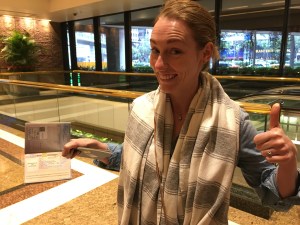
Russian visas obtained! If our experience with the consulate is any indication, Russia will be super ‘fun’.

We did a fantastic free walking tour through Hong Kong Free Tours. Our tour guide Alla was a native Hong Kong-er (Hong Kong-ite?) and we learned a lot about the history of the British colonial period. I was surprised to learn how much Chinese principles like feng shui (and other crazier superstitions) have shaped the skyline of Hong Kong.

After working up a good appetite walking, we went to Lan Fong Yuen milk tea stall- they make a delicious sweet milky tea and claim their secret is filtering the tea leaves through a lady’s silk stocking. After like 4 milk teas, we went to a noodle shop for and had the best pork noodles of my life. We can’t remember the name in English but we took a photo of the name in Cantonese (see below). The pork is seared so it has a super crispy crunchy skin; when you eat it over soup noodles its like crunchy croutons of pork in the bowl. It was glorious, and I made us go back twice.

Another highlight of Hong Kong was seeing Jeff get in on a game of pick up soccer with some high school kids. He’s the sweaty white guy in the photos below. There were many high-fives and fist-bumps, so I think they had fun.

Overall, it was a good introduction to Hong Kong. It will definitely be a fun city to explore more in the future! The next stop is sweltering Malaysia, where we’ll visit Kuala Lumpur, Ipoh, and Penang.

P.S. This post has a bonus question: what word in English translates to ‘skin grass’ in Cantonese ? Hint: see our photos above (Thanks Judy!).

Vietnam- the adventure begins!

Jeff arrives in Vietnam!!! And the trip begins.

We split our time in Vietnam between Ho Chi Minh City (HCMC to the lazy) and Hanoi – about 4 days in each. Our time in HCMC was fairly uneventful compared to trip past (i.e. I wasn’t robbed by punk kids on a moto), and we mostly revisited the sites of our previous adventures.

For our first meal of the trip, we headed straight to Mumtaz- an Indian restaurant that over the years has provided us with much respite from HCMC’s grim backpacker fare. We were happy to see that although things had changed a bit, the longstanding menu typos remained and the food was tasty. That evening, we kicked off the trip right with some tepid Tiger Beers in a filthy alleyway with primo people watching. The next morning, we made our first visit to a Starbucks in the Socialist Republic of Vietnam. On our first trip 10 years ago – Starbies definitely wasn’t happening. See the fun below.

After a healthy dose of nostalgia, we headed north to Hanoi. I couldn’t talk Jeff into doing 24 hours on a bus again (such a diva), so we flew. Hanoi was a treat – I’d forgotten how different it is from south Vietnam. There are so many intact colonial buildings, and the whole vibe is less chaotic and stressful. We spend a lovely day exploring museums with the delightful Andrea and Michael, and ate tasty bun cha – which, we were told repeatedly, was a favorite of Barak Obama.

On our last day in Hanoi we visited the mausoleum of Ho Chi Minh. Despite his final wishes to be cremated, the Vietnamese socialist party decided to preserve Uncle Ho’s body Lenin-style, and display his ‘visage’ to the adoring public in a meat-locker like mausoleum. In order to actually get inside the mausoleum – which was, you know, why we were there – we had to go through the whole queuing process twice. The first time through the line we were not issued a ticket, which costs no money and seems to require you just ask for it. After a security guards demanded it, we queued again for 20 minutes to get said ticket. At the end of the line, I asked for my ticket. The guard yelled, “There is no ticket!”. I just stood there for a full minute staring at him until someone waved us into a line that was headed inside the building, so whatever.

Most of the other people going inside were Vietnamese and they looked like they might be country folk. It really was fascinating to see the reverence with which people visit the mausoleum. Ho Chi Minh is still very much regarded as a champion of the Vietnamese people by much of the north, and you realize how critical a strong figure like Minh was during the American War.

And speaking of Viet Cong…. after a solemn morning at the mausoleum we hit up a Viet Cong themed coffee shop called CỘNG CÀ PHÊ (sidebar: I found my new favorite drink- coconut coffee!!!!). The CỘNG CÀ PHÊ is a post-ironic hipster reimagining of a Viet Cong jungle camp. From the $50 knock-off TOMS (called CONGS, of course) to the pseudo-jungle latrine to the Soviet star in the latte froth, the whole thing is hysterical. And weirdly, really really well done. I’m pretty sure that this gross commercialism isn’t quite what Uncle Ho had in mind as he lead the communist resistance movement, but frankly the existence of CỘNG CÀ PHÊ actually encapsulates the real victory of the Vietnamese people. Bad things have happened, we’re over it, now let’s make lots of money off of people less crafty than us.

Now, onward and upward to Hong Kong!