Greece Part 1- Athens

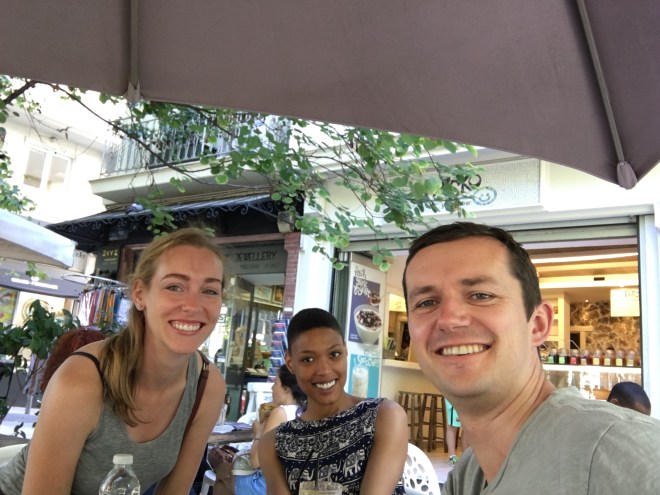
Have I over used the phrase ‘surprise delight’ lately? Too bad, because Athens was a surprise delight. A few years ago Jeff and I had a long layover in Athens, just long enough to gaze up at the Acropolis and eat a sad, overpriced tourist lunch. Our impression was that Athens is a crowded, ill managed, and chaotic city with lots of concrete and little charm. I suppose that the aforementioned disses hold true, but we were unexpectedly delighted by our time in Athens on this trip. Perhaps we just needed more than 5 hours to escape the city’s (admittedly hellish) tourist gauntlets and soak up some of Athen’s grittier urban charm. My sister Callie joined us for the Greek part of the adventure, and having another human around for our adventures was a real treat.

IMG_6069
Callie’s here!!! We broke out the selfie stick for the occasion.
The Kipsali Neighborhood

We stayed in Athen’s Kipsali neighborhood, which certainly helped to revise our opinion of Athens. Kipsali was developed in the 1930s with apartment buildings to house middle class Athenians. The area was booming and heavily developed up until the 1960s, when some fairly ugly but not unforgivable buildings were constructed. During the 1980s most of the original middle-class occupants of the neighborhood moved to the Athenian suburbs, and the area fell into disrepair. Google ‘Kipsali’ and you’ll find TripAdvisor threads asking ‘Is it safe?’ and lots of negative comments about ugly commercial buildings, graffiti, and immigrants (mainly African and Arab). So basically, Kipsali is just our kind of neighborhood. We found some phenomenal restaurants, cafes, and bakeries in the neighborhood and we got a taste of a ‘real Athenian’ neighborhood. There are interesting sidewalk joints, old-school businesses from the 1930’s, and yeah, maybe a few crackheads, but just avoid Pedion Areos park at night and you’ll love Kipsali.

Around Athens

We did a free walking tour of Athens with a comically English chef-slash-tour guide named Martin, and he showed us all the best spots in central Athens to eat and explore. Although the downtown area is clogged with more tourists than you can possibly imagine, there are some surprisingly pleasant spots to have a quiet moment. Martin took us to the Pnyx, a rocky hill near the Acropolis where ancient Athenians gathered to debate issues on the ‘bema’ (speakers platform) and hold public votes. Athenian assemblies were held here as early as 500 BC, and this is basically the birthplace of the concept of democracy. The Pnyx had a very mystical and special presence, and the stunning views over the city and up to the Acropolis were pretty nice too.

Martin’s walk included more ancient sites than I care to bore you with, but a few were particularly interesting. My favorite site is a small and seemingly unimpressive building called the Tower of the Winds. Built between 200 and 50 BC, the octagonal tower has eight sundials and was the first public clock tower. The top of the tower is a weathervane, so ancient Athenians could tell which way the winds were blowing and predict weather patterns. The coolest part, however, was a mysterious water work that archeologists have now deduced was a water clock so that time could be kept at night. It amazes me that an ancient city had such a strong insistence on access to knowledge for its’ citizenry, and it highlights what a special place Athens held in the ancient world.

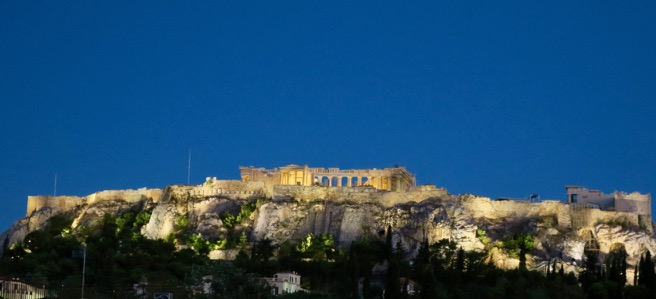
Oh, and the Acropolis! The site was C-R-O-W-D-E-D, but we did a ‘skip the line’ tour to visit the Parthenon and Acropolis hill and it was the right choice. Our tour guide Evita was a sweet archeology teacher who gave us a lovely overview of the site and we really enjoyed what could have been the hottest and ickiest part of our time in Athens. Much like Ankor Wat in Cambodia or the Pyramids in Egypt, the Acropolis was crawling with visitors, but somehow these monuments are so special that the crowds and chaos don’t detract from the experience. It seems like the opposite should be true, but I’ve found that when you’re seeing something truly amazing it doesn’t really matter if there are 10,000 Americans from the mid-west wearing baseball hats and Nike sneakers (re: images below).

So there is yet another surprise delight from our adventures. We expected to hate Athens and be murderous over the crowds, but it turned out to be a surprisingly pleasant high point of the trip. Athens is gritty and crowded, but it really does have urban charm when you spend time getting to know it. After 5 days in Athens we bid adieu to Athens took the train up the coast north to our next stop – Thessaloniki.

But first, let’s do an Athens Special Feature – Cats of Greece

Cats of Greece

Much like our beloved Lebanon, Greece is crawling with furry friends. I mentally add like 10 minutes to the time it will take us to walk anywhere in Greece because there will be so many cats that need to be greeted along the way.


Bulgaria – A Surprising Delight

As I said, Jeff and I knew basically nothing about Bulgaria when we decided to visit on our Balkan detour. I had a vague notion that Bulgaria is slightly Greek and slightly Turkish, and one of Jeff’s favorite soccer players, Dimitar Berbatov, is from Bulgaria. So there’s that. From Brașov, we took the very, very slow train ride south to Sofia via Bucharest. Come on, it’s not that far! I really don’t know why it took 13 hours.

We split our time in Bulgaria between Sofia and Plovdiv and I am pleased to report that both cities were surprise delights. That’s the fun part of visiting places blindly: if it sucks (ehhh, Brasov?) then you’re not really disappointed, and if it doesn’t suck you’re very pleased. The food in Bulgaria is like, 60% as good as Greece (which is a huge compliment) and the cities are pleasant, interesting, and manageable. Oh, and it’s super cheap. Bulgaria has absolutely been one of the best surprises on the trip.

Sofia

Bulgaria’s capitol city Sofia was originally settled by Thracians (a Greek-ish tribe) sometime before the 6th century BC, and later flourished as a Roman city called Serdica. Serdica was a major city in the Roman Empire and Bulgarians oft quote Constantine the Great as having said “Serdica is my Rome”. You’ll find tourist tat all over the city emblazoned with this questionably accurate quote. After the Roman era, Sofia was the seat of several Bulgarian empires before coming under Ottoman rule in the 1382 AD. The country was ‘liberated’ by the Russians in 1878, and after various shifting alliances joined the Eastern Bloc of communism in 1946. Bulgaria has been slowly modernizing since the fall of communism in 1989, and joined the EU in 2007. Sadly communist architecture did leave its mark on Sofia, but it’s still a very pleasant and (somewhat) attractive city full of interesting history.

To get our bearings in Sofia we did the ‘Free Sofia Tour’, and it was our best free walking tour to date. Our tour leader Slavyan marched us around Sofia’s historic churches, the former royal palace, and the now defunct public bathhouse (damn it). He also gave us a surprisingly thorough history lesson (see above). Sofia reminded both of us slightly of Beirut in that there are excavated ruins dotting the modern city. Near our hotel was an excavation of a Roman era bath right next to a garish meat-head gym. So many antiquities were uncovered when they built the subway lines that many of the stations have in-situ displays of parts of Roman ruins and monuments – it’s like an organic museum underground. This city definitely doesn’t get credit for how interesting of a city it is, and we thoroughly enjoyed our time there.

Bachkovo Monastery

A highlight was the day trip we did by bus to Bachkovo Monastery, which was founded in 1083 and is one of the oldest Eastern Orthodox monasteries in Europe. The monastery was founded by a Byzantine prince but was largely influenced by Georgian monks, and it’s a fascinating blend of Bulgarian, Byzantine, and Georgian decorative motifs. Like other monasteries in Bulgaria, parts of the building are decorated with unique exterior frescos, and the interior halls are some of the prettiest I’ve seen. The day we visited was rainy and misty which definitely gave the whole monastery an atmospheric and mysterious vibe.

Plovdiv

After 5 days in Sofia we took the train to Plovdiv – a city that should consider a name change. Plov – div. It just doesn’t roll off the tongue. Like Sofia, Plovdiv is an ancient city with Roman roots. It’s one of the oldest cities in all of Europe, dating back to the 6000 BC. It has a well-preserved historic center and retains a lot of Ottoman era flair. One of the most interesting sites in Plovdiv isn’t really a site yet – it’s the unexcavated ruins of the Roman era hippodrome, or chariot-racing stadium. Like the hippodrome we saw in Tyre this thing is huge, but right now only a small portion is visible in the central square of Plovdiv’s Kapana neighborhood. The length of the hippodrome runs along Plovdiv’s main shopping street, and there is understandable hesitation to destroy the center of the city. You can actually see parts of the stadium in the basements of some shops, and the H&M has a particularly good section visible.

Plovdiv was recently designated the European Capital of Culture 2019, and while everyone is really excited about this distinction no one had a satisfactory explanation for what exactly this meant. Plovdiv has a sense of excitement and optimism that is rare indeed in former communist cities, and I hope that this EU initiative does indeed bring more tourists and money to the city. Plovdiv deserves it.

Bulgarian Gypsies

But lest I paint an overly rosy picture of Plovdiv and Bulgaria, I have another gypsy story for you. Oh yes, Romania’s gypsies are more well-known but Bulgaria has quite a sizable gypsy/ Roma population as well. (side-bar: Gorat dedicated several minutes to the theme of ‘Romania’s gypsies look better than Bulgarian gypsies’. Sadly I agree with him after seeing what I’ve seen.)

Unbeknownst to me (until the incident), Plovdiv is home to Europe’s largest ‘gypsy ghetto’. On the outskirts of town, the area is called Stolipinovo and is home to around 50,000 gypsies (here’s a fun documentary about it). Stolipinovo is a collection of crumbing socialist era apartment blocks with almost no infrastructure – no water, no power, and often no sewer system. It’s a horrible place, and a few high profile public health crises have brought it international attention to the slum.

Okay, now the incident. Because we loved the Sofia Free Tour so much we did the same company’s Plovdiv Free Tour. The tour started out pleasant and uneventful, and our enthusiastic young guide walked us through the old Plovdiv’s main sights. He took our group up the narrow cobbled street leading to Nebet Tepe, the highest point of the old city and an active archeological site, where we took a break under a tree for shade. Suddenly, we heard galloping and a crazed looking horse came running wildly up the street and into the center of the hill, where he rampaged in circles and kicked his hind legs frantically. This hill is not huge, and it was difficult to avoid the deranged horse. Chaos broke out. There were about 20 adults and 4 children from all over the world on the top of a hill screaming and bolting in all directions. At one point the horse had his sights on Jeff and he thought, ‘This is how it ends’.

Eventually some very concerned construction workers ran up to the hill and told our guide that this horse had escaped from the gypsies. My ears perked up – gypsies?!? Eventually the construction workers managed to chase the horse in the opposite direction of our escape route, and our poor tour guide screamed at us to run down the hill. It was by far the most exciting free walking tour I’ve ever had, and I had a new agenda for the rest of our time in Plovdiv. Find the gypsies.

I interrogated our still rattled tour guide about these gypsies. Where do they live? Can you visit them? How do I get there? He gave me some rough directions, and said he ‘thought I could walk there’, though he never had. I researched this neighborhood later that day and found about the dystopian tragedy that is Stolipinovo. Naturally, I began convincing Jeff to visit this place.

The next morning Jeff and I set out to find the gypsies on foot. We made it like half way, but got spooked by a gypsy driven horse-cart that was tailed by a pack of angry stray dogs. I really don’t like stray dogs, and the on-foot mission was aborted. Next we went to the visitor’s center in downtown Plovdiv and asked the incredibly pleasant and eager young staff it if it was possible to visit the gypsies. Three-quarters of the staff said a definitive ‘No’, but one girl told me, ‘Oh yeah, you can easily take the number 116 bus. Get off on the last stop.’ So we’re back in business.

The ride from Plovdiv’s center was short but the starkness of the contrast can’t be overstated. We pulled off the main road onto a series of increasingly creepy lanes, and finally came to a collection of like 30 utterly post-apocalyptic ex-communist apartment blocks. These buildings were crumbing and decrepit, and each yard has about 20 guys in lawn chairs just… hanging out. The unemployment rate is estimated to be over 90% in Stolipinovo, and no one seems to have anything to do. We saw a couple of micro-markets selling soda and beer, but not much else. The streets were peppered with wild dogs, children in wagons, a bizarre number of discarded limousines, and yes, horses. Remember, this is in the middle of the second largest city in Bulgaria, not some rural village.

We only took a few photos from the bus, but here is a really great photo essay about Stolipinovo that gives you the sense of what it’s like. So there is the good with the bad. Bulgaria is a wonderful place to visit and you certainly get the sense that things are improving for most people, but there is always more to the story. Stolipinovo is obviously an extreme example, but it highlights the challenges that so many countries have with taking care of their poorest citizens.

For a completely uninformed destination, Bulgaria turned out to be a highlight. The history is fascinating and deep, it also gave us a good amount of time to relax sans tourist hordes before the next endeavor: Athens, Greece. Bring on the crowds.
Romania – Of Gypsies and Beekeepers

Small disclaimer: I’m going to be using the word ‘gypsy’. This word is regarded by many to be a racial slur, but this is the word they say in Romania. And they say it a lot. Every time I used the P.C. approved ‘Roma’ and ‘Romani’, people yelled back at me, “What is this word?? I don’t understand you. Do you mean gypsy???” Alright, fine. When in Romania do as the Romanians do. Gypsy it is.

After bidding adieu to the Sherlocks in Budapest, we boarded a night train to Romania’s Transylvania region for our Romania Detour. This was hands-down the best sleeper train ever, but I won’t bore you by enumerating all of its many delights. Let’s just say that we had a private cabin so there were no 6 am hotdogs (fun though that was) and we had a sink and shower (eee!!!) in each car. I could have stayed on that train for a full week – it was that great. Actually, I spent much of the next week wishing I had in fact stayed on that train, as the shower situation awaiting me in Brasov was grim…

Brașov

Upon surveying the sparse crowd at the Brașov train station, Jeff and I were satisfied that we had evaded the tourist hordes endemic to European summer. Brașov is the de facto tourism capital of Romania’s Transylvania region, and it is the embodiment of ‘Romanian village’. Nestled between the Făgăraș and Carpathian mountain ranges, Brașov’s old city is a maze of medieval streets, crooked timber storefronts, and a sea of craggily red tile roofs. It’s very cute in the summer, but I couldn’t help imagining how cold and isolated this place must feel in the winter. Brașov is home to the beautiful Biserica Neagră, or Black Church, so named because of a massive fire that damaged the church during the Great Turkish War in the 1600s. Luckily the church was mostly restored and now faces a very lovely central pedestrian promenade selling some oddly good pretzels. Brașov is sleepy, but its a perfectly peaceful little town to spend some time in.

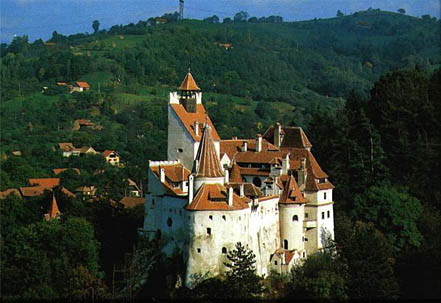
Most people use Brașov a home-based to see Transylvania’s fortresses and castles, notably the legendary Bran Castle. Billed as the home of Vlad Țepeș (aka Vlad the Impaler), Bran Castle has to be one of the most effective marketing ploys of the modern tourism industry. While it is true that Vlad Țepeș lived and impaled in Transylvania during the mid-1400’s, he did not live at Bran’s Castle. At best maybe he stayed at the castle for a week… and yet the tourists flock.

Bran_panoramic_edit-x01
Bran Castle- where Vlad Țepeș never lived!!!
The Gypsies

While we do enjoy gory historical figures, what I wanted to see in Transylvania were some gypsies. (This is offensive; see the above.) My intrigue probably originated from my great-grandmother’s threat that naughty children (i.e. me) would be sold to a band of gypsies. I never saw said gypsy bands roaming Ogden, Utah, but this in no way mitigated the threat and actually made gypsies seem mythical, like mermaids or elves. (Again, offensive. Again, see above.) As an adult I think that I’m intrigued with Roma – ahem, gypsies – because they are a historic relic from a time when the world wasn’t delineated into the nation states of today. A stateless people spread across Europe, persecuted by the Nazis, and severely disenfranchised by communism, the gypsies have not fared well in the modern world. Many gypsies now live in cities, but the Romanian countryside is dotted with ‘gypsy villages’ often on the outskirts of larger so-called ‘Saxon villages’.

Given their history, it is not surprising that modern day gypsy communities are secretive and suspicious of outsiders. You can’t really visit a village on your own and have an interesting experience. After much scouring I found exactly 3 tour guides in Brașov offering trips to gypsy villages, and I contacted them all. The replies were very Goldilocks’ porridge.

Guide 1

“Unfortunately, we no longer do gypsy village tours. Each time we visit the gypsies they extort the tourists for lots of money. “

Guide 2

“I CAN ARRANGE A TOUR WHERE YOU STAY WITH THE GYPSIES OVERNIGHT AND YOU CAN SKIN A RABBIT AND YOU CAN TAKE THE RABBIT FOOT AND YOU CAN EAT THE RABBIT. But you need to bring your own salt.” (I’m not exaggerating this in the slightest. Not even the salt part.)

Guide 3

“Sure. I can take you to a gypsy village on Tuesday at 9:00 am.”

Great, this was our guy. We didn’t have to skin any rabbits, but it did turn out our guide was essentially Borat’s Romanian cousin, who I will call Gorat. (note of interest: the Borat movie was actually filmed in Romania, not Kazakhstan.)

We began our day with Gorat and the gypsies by doing a little grocery shopping. Since gypsies aren’t very open to strangers you need to arrive with some kind of offering. Our offering was like 15 cabbages we bought at an oddly good farmers market on the outskirts of Brașov. Provisions secured, we headed north for a long drive in the Transylvanian hills and like any good road trip we learned a lot about Gorat as we settled in. He believes in the magical power of bee pollen, thinks that homeless people and beggars are lazy, and is convinced that a man’s true strength sets in between the ages of 35 – 40 (good news for Jefferboo, I guess). He learned a bit about us too, repeatedly asking me if my ‘teeth are mine’. Yes, Gorat, they’re real.

One of Gorat’s road trip games was a version of ‘Slug Bug’ called ‘Spot the Prostitute’. Every time he saw a woman on the side of the road he’d yell out, ‘There’s a prostitute!’. When I’d optimistically offer that maybe she’s waiting for a bus, or perhaps meeting a friend, he’d say, “No, I know her…”. It was a fun game, and the fewer questions asked the better.

It took several hours on a succession of increasingly poor roads, but we finally made it to the gypsies. With such a long build up I’d love to tell you that we fought a bear and rode a donkey, but the gypsy village was very subdued. It turns out the gypsies are just normal, super poor rural people with no support from their government. We spent some time with a woman named Irena and her 18-year-old daughter Alena. Over cookies and super sweet schnapps, we talked about Alena’s interest in carpentry, the high cost of schooling, and how few services the Romanian government provides to gypsies. Irena showed us around her property, her horse stable, and her rabbits, which luckily we didn’t kill (phew). Our time with the gypsies was far less insane than my initial research had suggested it might be, but it was a really great experience to spend some in a village and see the reality of life in rural Romania.

The Beekeeper

After we left the gypsies Gorat drove us around the Romanian countryside for a while, which I have to admit is uniquely beautiful and bucolic. Along the way Gorat peppered us with questions about being a truck driver in America (it seemed that was his long term career aspiration), and why we don’t just build a wall and send the Mexicans “home” (this was a bit hard to dive into during a leisurely drive).

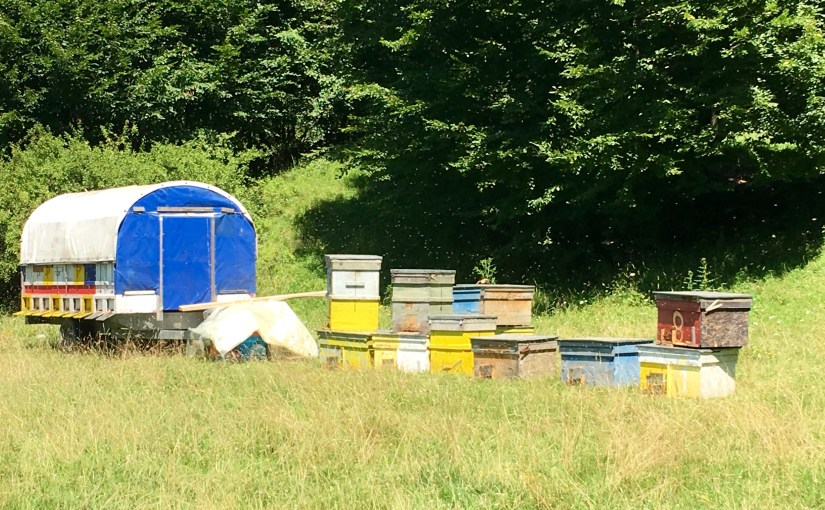
As we headed back to Brașov, I spotted some beehives on the side of the road and asked Gorat to pull over (which he did since he loves bee pollen). It was also a good respite from the barrage of questions Gorat had about being a truck driver in America. The beekeeper was a delightful pensioner, who had gotten really into his beekeeping hobby since retiring. He lived near the Black Sea, but for reasons that were never fully explained was taking his bees on a 500 mile road trip across Romania. His bees lived in a sweet caravan-hive and he was camping out in a bright yellow van. He was perplexed when we asked to buy some of his honey, but and after rummaging around in the back of this van-cum-bedroom he found some empty water bottles to fill up for us. This stuff is absolutely excellent. It’s the real deal, and it was a treat to meet this beekeeper.

So that’s our Romania detour. Oh sure, Croatia has its beautiful coastlines and beautiful people, but you know what it doesn’t have? Gorat, gypsies, and beekeepers. Well, I’m pretty sure they have gypsies and beekeepers, but our Romanian detour had a bit more adventure and circumvented the crowds, so, great success!

Stay tuned for our next stop of the detour as we head south to Bulgaria – a country that we know absolutely nothing about!!!

The Romania Detour (and Bulgaria too!)

Sometimes the best laid plans need to be revised… Allow me to explain.

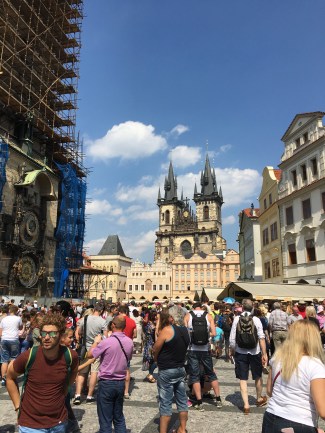
We had planned our travel route almost a year ago, and from the comfort of home it’s easy to forget how unpleasant the crowds can be in Europe during the summer. As we were shivering on a chilly San Francisco July morning, we thought ‘yeah, Croatia for two weeks in July will be great!!!’. Sadly, oh-so-many other Europeans and Americans agree. We’d regretibly forgotten this fact, but crowds of Prague effectively refreshed our memories. Do we really want to spend two weeks in Croatia being surrounded by highly tanned and manicured compatriots calling each other ‘Babe’? No, we decidedly did not. Plus, the motto of our trip is ‘to do hard stuff now that we won’t do later’, and the Croatian coast will always be there.

IMG_5272
The crowds in Prague!!!! The horror.

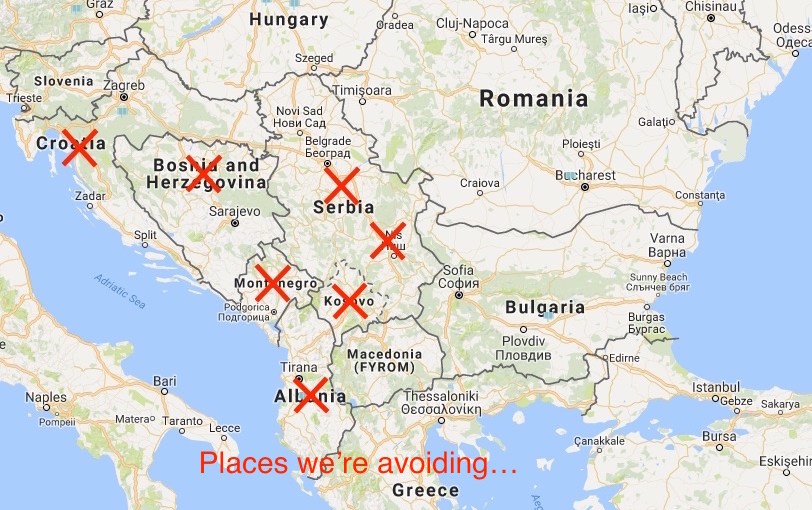
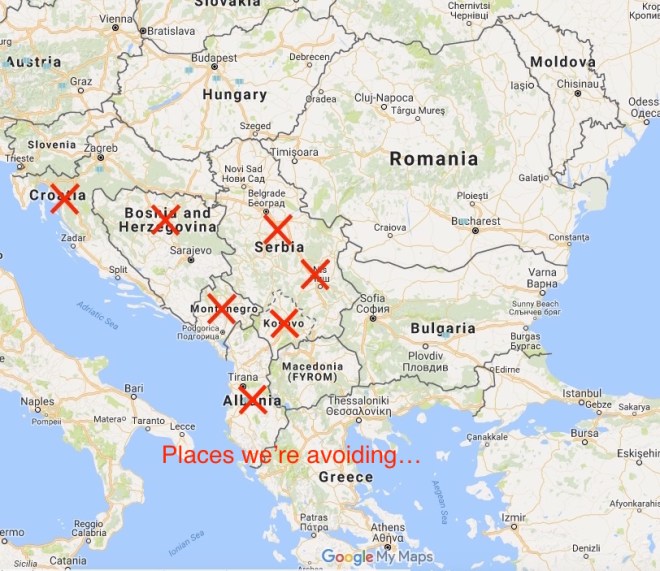
Thus, after much consternation, we canceled our reservations in Croatia and scrambled to find a lesser considered European destinations. We needed to be in Athens in 2 weeks to meet my sister, so we needed to stay in the same geographic area. Montenegro, Bosnia, and Serbia are all lesser touristified countries nearby, but we’ve already spent time in these places and weren’t keen on going back (Serbia, I’m still holding a grudge). Also, Jeff really doesn’t want to go to Albania or Kosovo (I think just to spite me). This requirement rubric in mind, here’s what our map looked like.

map
We are here…
map copy
We need to be here…
map copy 2
We don’t want to go here…

Our choice was clear – Romania and Bulgaria here we come. We have no idea of what to expect from these countries, but I’m just hoping there are fewer tourists in Plovdiv than in Dubrovnik. (side bar: these countries really some PR help to rename some cities. Plovdiv?? Really?)

Budapest – It Is Grand Indeed!

The train ride from Prague to Budapest was relatively uneventful, but getting to our AirBnb more than made up for this lack of excitement. It became immediately apparent that Budapest is significantly more Eastern European-y than what we’d gotten used to. Elderly Roma ladies blew cigarette smoke in our faces, our Airbnb host was late because the Pride Parade was under police control (really), and our attempt to secure a 3-minute taxi ride was met with a demand for 25 €. When we found a reasonably priced taxi, the driver was alarmingly frantic to get us into the car. Of course, there were 5 of humans and 15 suitcases, so this was an issue. I decided to stay behind, but as the car pulled away I realized that I was the only one who knew how to find the Airbnb. Jeff jumped out of the moving taxi and I chased it down the street to jump in. All the while the driver was screaming and the Sherlocks were terrified. Welcome to Hungary.

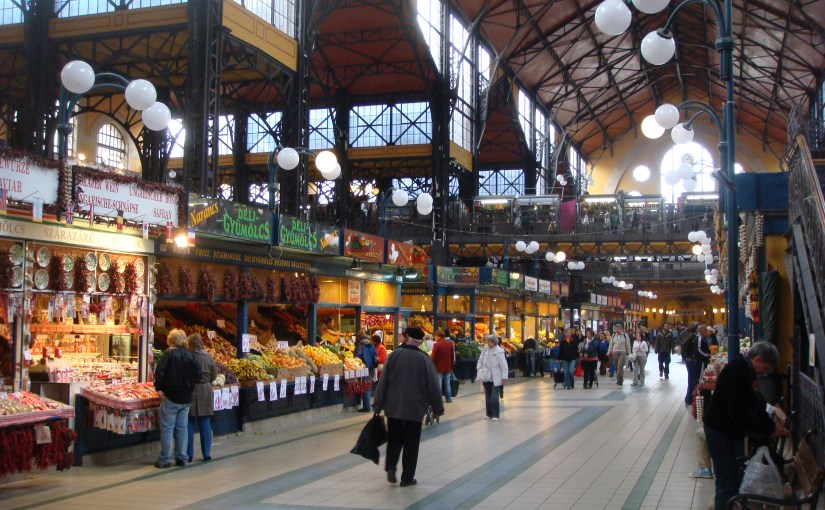
After the debacle was resolved and we were settled in our AirBnb, we were pleasantly surprised to learn how fabulous Budapest is. It truly is grand!!! Modern Budapest is made up of two ancient cities, Buda and Pest, which were unified in 1873 and lie on opposite banks of the Danube river. The city is simultaneously modern and charming, has a decent public transportation system, and is super cheap. Budapest attracts some tourist hoards (namely stag and hen parties from the UK), but the types of attractions are pretty diverse for such a small city. Budapest boasts a lively party scene, lots of great foodie options, beautiful historic buildings, and plenty of cultural intrigue. Both Jeff and I agree that Budapest is probably one of the best ‘tourist’ cities we’ve been to on this trip. Go visit Budapest!!!

Budapest-Freedom-Bridge-6626
Cute old (and new) bridges join Buda and Pest.

In keeping with this theme of touristic diversity, I’ll highlight 3 top things during our time in Budapest: more Jew stuff (!!), the public baths (!!!), and IKEA (!!!!).

Jew Stuff

Unbeknownst to us our AirBnb was located in the old Jewish Quarter, and this was a big hit. Right around the corner from our apartment was the Kazinczy Street Synagogue, which was built in the 1909 and has amazing Art Nouveau flair. Budapest was booming in the 1910’s to 1920’s, and the ornate and stylized details in this synagogue capture the sense of those roaring decades. It’s sobering to think about what energy, creativity, and vision went into building the Kazinczy synagogue when you realize that Budapest’s Jewish community would be decimated a mere 25 years later.

We also visited the famous Dohány Street Synagogue, or Great Synagogue, which was built between 1854 and 1859. The Great Synagogue is the largest in Europe, and is built in a very grand Moorish Revival style. Next to the Synagogue itself is a cemetery, which is unusual in Jewish tradition. It is a sad reminder of the fact that over 10,000 Jews died in the Ghetto of Pest between December 1944 and January 1945, and the synagogue became a makeshift cemetery for nearly 2,000 Jews out of necessity. The graves are part of the Raoul Wallenberg Holocaust Memorial Park within the synagogue complex, and the park is a lovely but very sad reminder of tragedies in Budapest’s not-too distant past.

Baths

Not surprisingly, for me the highlight of Budapest was the baths. Having done many baths (and bath-like activities) on this trip, I can say with confidence that the baths in Budapest are something special. Unlike Turkish hamams, many (though not all) of the baths in Budapest are actually geothermal pools. Many of these pools are large enough to swim in, and magnificent structures were built to house them during the turn of the last century. The archways, intricate tile work, and stained glass skylights of these grand buildings transport you back in time (or at least to the set of a Wes Anderson movie). There are over 100 bath houses in Budapest, so it can be overwhelming to pick a bath. We settled upon the nearly 100-year old Gellert Spa for our baths (twice, actually) since they are large, beautiful, and co-ed.

Unlike spas in the US where people relax in quiet solitude, Gellert Bath has a lot going on and people spend their spa days doing weird stuff like eating ham sandwiches. There is an outdoor wave pool, a lap pool, a sunbathing area, and an old school café (evidently serving ham sandwiches). We elected to spend our time luxuriating in the indoor thermal pools, steam room, and sauna, and it was an excellent use of time. There are 10 thermal pools with an unnecessary granularity in temperatures. Do we really need a 30° C bath and a 31° C bath? Apparently so. The hottest pool is 40° C (104° F) and the coldest pool is a brisk 15° C (59° F), so being a masochist I focused attentions herein. The Sherlock clan spent two fun (and eventually woozy) days jumping between the hottest and the coldest pools, then running to the sauna. I loved it so much…

IKEA

A trip to IKEA isn’t most traveler’s idea of cultural immersion, but I always visit home and hardware stores when we travel. Adding to the appeal of IKEA destination, the whole Sherlock family (myself included) has a borderline-unhealthy fixation on diminutive kitchen appliances and bathroom fittings, so IKEA it was (or ‘Icky-a’, as our taxi driver Attila called it). We all have our personal passion project: Liz is really into tiny bathroom sinks, Jeff wants a super skinny refrigerator, and I’m just still depressed that IKEA discontinued my favorite sofa. It was fun (but sad) to fall in love with the different products at IKEA Budapest, and fantasize about how great our lives would be if we could just get that skinny fridge. But I guess that that is what IKEA is all about, isn’t it? Convincing yourself that your life would be so great and simple if you just lived in that tiny but immaculately beautiful 300 sq ft apartment…

Farewell Sherlocks!

After a week immersed in Budapest, it was time for the Sherlocks to go home and for Jeff and I to get aboard a 14 hour train to the heart of Transylvanian. Stay tuned for the Romanian revision…