After Russia, we broke through the Iron Wall (briefly) and made it back to the western world as we know it – Berlin. Normal food!!! Normal currency!!! Normal social conventions!!! It’s good to do easy things for a while.
Jeff and I visited Berlin in 2009 and we were excited to revisit the city. As an added bonus, Jeff and I were excited to be joined by the Sherlock clan for the Berlin-Prague-Budapest segment of our trip. When you spend every waking minute with one other person you exhaust conversation materials, and evidently rich conversational topics like ‘that new font I’m trying out on my Kindle’ were falling flat with Jeff… We hadn’t had travel companions since Sri Lanka, and after 5 months on the road we were ready to be with some linguistically compatible humans. It was great to see familiar faces from home and have a completely captive audience for our travel tales. (sidebar: the new font is working out great; it’s Palatino.)
The whole Sherlock clan at the defunct Tempelhof Airport in Berlin.
When Robert puts on sunglasses he becomes The Most Interesting Man in the World. “I don’t alway drink Diet Coke, but when I do I drink it out of a comically tiny glass.” (actually, both of these statements are abject lies.)
Lots and lots of Diet Coke.
Jeff and I arrived to Berlin before the Sherlock clan so we could prep for their arrival. We bought Diet Coke.
Our Airbnb had a tiny glass elevator big enough for an operator (i.e. me) and several suitcases if you Tetris it well. This was elevator round 3 of 5.
We spent our time digging into the fabulous museums in Berlin – some we’d visited before and some that were new to us. The first stop on our museum exploration was my all time favorite museum – the Pergamon Museum on Berlin’s Museum Island. The Pergamon Museum is home to the beautiful Gates of Ishtar – which were built in 575 AD and surrounded the city of Babylon in what is modern day Iraq. The gates were even more beautiful than I remember, and the museum has dedicated a special committee to preserving works from Syria. They are not displayed, but the Pergamon has a collection of funerary busts from the recently destroyed Roman city in Palmyra, Syria. I hope we get to see these next time we visit!
The entrance to the Pergamon Museum.
Painted wall panels from a merchant’s home in Aleppo.
A view of Museum Island from the river Spree.
A frieze from the front of a Roman era market.
The Pergamon has so much pottery from Uzbekistan!!!
Jeff and I with the Gates of Ishtar. I’ve named the two lions behind us Kip and Kevin.
This is Kevin… so cute.
Fabulous Bauhaus potter at the Berlin Museum of Applied Arts.
I love this pottery so much…
They had some great furniture too.
In addition to the antiquities museums on Museum Island, we visited the Topography of Terror exhibit – an exhaustive documentation center for life in Berlin during the Nazi regime – and the super fun DDR Museum – a lighthearted look at everyday life behind the Iron Curtain. My favorite exhibit at the DDR Museum examined communal toilet training for kindergarteners in East Germany. Evidently, this was a thing, and kids were made to tinkle (or poop, presumably) in a giant trough with all their classmates. You weren’t done until everybody was done. The idea was to… instill a sense of community? Sadly, for reasons that weren’t entirely explored communal potty training fell out of fashion…
Praha
After a week of museum-ing in Berlin, we took a train south to Prague, Czechia. (Yes, that really is what Czech Republic is going by these days.) We’d been to Prague a few years back on a long layover, but I’d forgotten what a touristy city it is. Man, is it touristy. The old town is adorable and extremely well preserved (thus the tourists) but it was a shock to our systems to be on the ‘Americans-in-Europe’ circuit. In fact, our time in Prague sent Jeff and I into a panic about our planned destinations in heavily touristified European destinations (like Hrvatska). We made a rash (and probably regrettable) decision to cancel our time luxuriating on the Croatian coast for more, shall we say, authentic experiences. Stay tuned for more on that.
We are tourists!!! But you know the old saying. When in Prague…
Fighting through the crowds, we did manage to see quite a few gems in Prague. The highlight for the Sherlock contingent was the Prague Jewish Museum, which isn’t a museum (as I found out after many, many lines of questioning) but a collection of sites in the old Jewish Quarter. The capstone of the Jewish museum is the medieval Old-New Synagogue, which was built in 1270 and according to legend is the final resting place of the mythical Golem of Prague. I won’t deep dive here… just read the Wikipedia article on the Golem of Prague.
Near the Old-New Synagogue is the Prague’s oldest Jewish cemetery, which houses over 12,000 tombstones and many, many more tombs. The cemetery was active from1439 to 1787, and it one of the most visually arresting cemeteries I’ve ever seen. Over the 300+ years that the cemetery was active, new tombstones were simply placed in front of old stones and the grave plots were reused, resulting in a spooky layering of tombstones that is really stunning.
The adorable Charles Bridge in Prague.
I admit, it’s very scenic and cute.
Jeff channeled his inner Russian Jew.
The Old-New Synagogue in Prague.
The Jewish cemetery in Prague.
It’s definitely spooky.
The Spanish Synagogue
In addition to Jew-y stuff, we did an afternoon cruise on the Vltava river and spent some time exploring the city on foot. Jeff and I checked out the new hipstery ‘gentrifying’ neighborhood of Vršovice, and it was nice to get a taste of the city in neighborhoods that real people actually live in.
From Prague we took the train south into Hungary for our final destination with the Sherlock clan – Budapest.
As you may know a certain someone really likes soccer. It turns out that our time in Russia coincided with the Confederations Cup tournament – essentially a dry run for Russia’s 2018 World Cup. Surprisingly, Jeff didn’t realize this oh-so-fortuitous connection until like a week before we arrived in Russia, but once he did the internet was frantically scoured for tickets. He had great success. We saw Russia vs. Portugal in Moscow and New Zealand vs. Portugal in Saint Petersburg (or SPB, as I’m now calling it for reasons of brevity).
Since for some reason I am writing the soccer bit of this blog, this will be a short listicle. Here are some observations on the Confederations Cup:
Both Moscow and SPB were crawling with super earnest and excited young volunteers with information about the games. They were really helpful, and honestly might be Russia’s best asset.
The Russian police force are scary good at crowd control when they need to be. At the Russia vs. Portugal game in Moscow, there were nearly as many police as there were fans. It was seriously impressive. The security and crowd control in SPB was less impressive, but still not nearly as terrible as I would have expected.
The newly refurbished stadiums were for the most part well done. We didn’t see double toilets anywhere, and believe me I looked.
Public transportation to the stadiums was fantastic! The stadium in Moscow is more convenient than the SPB stadium, but both were really accessible.
Russian soccer fans seem to really like doing the wave. I think that this was the longest continuous wave I’ve ever seen.
The Russian patriotic chant is ‘ROO’-‘SIA’-‘AH’ chanted to the exact same beat as we American’s chant ‘U’-‘S’-‘A’. It would be confusing and fun to see a Russia vs. USA match.
Oh, and Jeff was super excited to see Ronaldo play twice. He piddled a bit (but not in a double toilet).
Overall, I think that Russia is pretty well prepared for the World Cup 2018. You read so many horror stories in the US media about what an ill-planned disaster these games are going to be, but now I don’t buy it. I think that the games will be fine and now I kind of want to go (but not as much as someone else does).
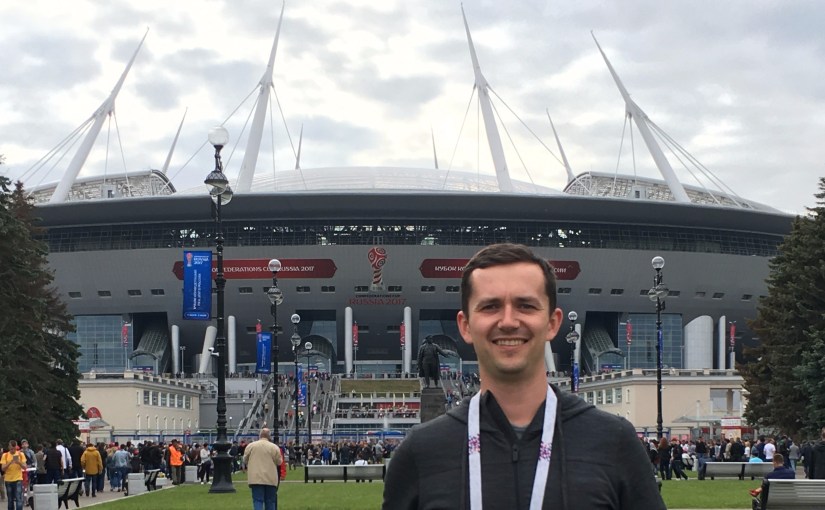
My Jefferboo at the game. He’s super excited.
ROO-SIA-AH vs. Portugal. Oh, the excitement.
The view of the stadium. There were like 40,000 people in attendance.
I’m cold… but fighting through it.
The New Zealand vs. Portugal game.
Saint Petersburg
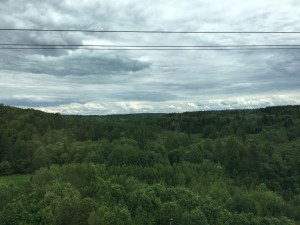
We traveled between Moscow and Saint Petersburg by high-speed train, which took a mere 4-hours and was quite comfortable. We passed through a green and idyllic swath of the Russian countryside, full of rustic wooden picket fences and thatched-roof cottages. I’m sure that in reality most of these rural villages are very poor and grim, but seeing them whiz by on the train gave rise to (unrealistic) fantasies about spending Christmas in a wee Russian village and all the attendant cuteness of a wee Russian village. I am already planning my next Russian trip.
Does Russia go on forever???
When we arrived in SPB I was honestly a bit surprised at how sterile the city felt. I’ve spoken to several travelers who describe SBP as magical and so much more interesting than Moscow. While SPB is definitely a lovely city, I have to say I found Moscow more enjoyable. There. I said it. SPB was founded by Peter the Great in 1703, and built by Swedish slaves captured during the Great Northern War. Because of this genesis, the city is orderly and Scandinavian. It’s lovely, but a bit… Scandinavian (i.e. super orderly and tame). To our amazement, SPB was even COLDER than Moscow. Russian summer is rough. Also, because SPB is so far north, June and July are referred to as the season of ‘White Nights’. The sun almost never sets, and it was a weird fever dream for the weather to be simultaneously cold and yet have the sun never set. Russia, you’re so weird.
During our time in SPB we were tired of the cold and getting a bit lazy, so visiting the Hermitage museum was our main activity (other than footie watching). It turns out that visiting the Hermitage is really, really hard, so it’s a good thing that we set our activity standards low. Founded by Catherine the Great in 1754, the main museum is now housed in the impressive winter palace of Tsarist Romanov family and is one of the largest museums in the world. The building and collection are spectacular, but doing things like, say, buying tickets, involves standing in lines that test my admittedly low patience thresholds. The Chinese have arrived at the Hermitage, and the crowds and lines really make it an unpleasant experience.
There were two things that I wanted to see at the Hermitage: the diamond room at the treasury (since lines thwarted my attempt at diamonds in Moscow) and the Bukhara room (since we were told of fabulous treasures in Uzbekistan). The former involved a 2-day process of line standing, and the latter either doesn’t exist or is so amazing that no one will tell you where it is. In any event, the diamonds were cool and the museum was crowded. That’s the Hermitage in a nutshell.
Here we are prepping for the line-stand of a lifetime at the Hermitage.
The exterior of the Winter Palace. Those lucky Romanovs…
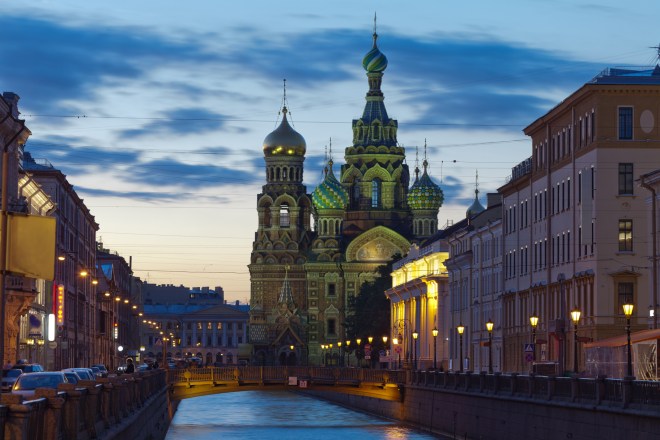
The gruesomely named Cathedral of the Spilled Blood. The exterior of this thing is amazing.
The interior of the CoSB is pretty gaudy. Better stay outside.
Other than seeing the Hermitage, footie watching, and a weird waxing experience, the only other activity we did in SPB was visit the very interactive Museum of Soviet Arcade Machines. The museum was quite a fun way to spend a chilly afternoon, but I still can’t believe that there were no Tetris games among the collection. When I asked the museum staff, they were very dismissive of Tetris and it’s place in Soviet gaming history. WTF, Russia? You need to honor the legacy of Alexey Pajitnov and his creation of the greatest game of all time. This is definitely the worst atrocity ever committed by Russia. Just kidding… but I’m kind of not. I love Tetris.
This 1970s ‘game’ (i.e. training simulator) has a geographically accurate depiction of the Baltic Sea. I guess tiny Soviet sailors have to learn somewhere.
Jeff sinking my battleship…
This is a test of strength game. You can either pull a ‘mouse’, a ‘cat’, a ‘dog’, a ‘little girl’, or a ‘granny’. I honestly can’t figure out the ranking of these categories.
Jeff pulled a ‘cat’ score. So… that’s… good?
This game was freakishly hard. It was a hockey version of foosball, but since you have to deal with 3-D (not 2-D) its really damn hard.
Vintage Soviet soda machines at the museum. I got a terrifying green drink that tasted like root beer.
Tetris oppression aside, we really enjoyed Russia. It was a surprisingly great place to visit, and I hope we get to visit again. Perhaps for my unrealistically cute Russian village Christmas? Our next destination is Berlin, where we’ll meet up with Jeff’s family. Stay tuned as we briefly break through the Iron Curtain!
Prologue: please watch this before reading to get in the mood. I hummed it for a week straight and I’ve been on a Tetris bender for the past 3 days.
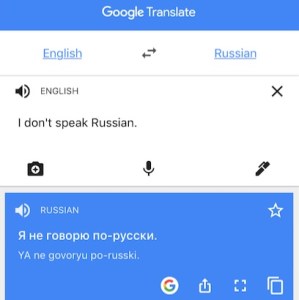
Upon landing in Moscow something became immediately apparent: Jeff looks Russian. Extremely Russian. This is not the first time that said-Russianness has been brought to Jeff’s attention, but it was the most persistent. When we lived in NYC Jeff’s Uzbek repeatedly insisted Jeff was Russian. Every haircut for two years began with a Russian greeting (or threat?), confusion, then the barber demanding “You speak Russian?!?!”. Nope. In Georgia and Uzbekistan, people would speak English to me, then turn to Jeff and speak Russian. “Ruski?!?”, everyone demanded. Nope. Even when presented Jeff’s American passport, people insisted that at the very least he must understand Russian. Nope. Thus, Jeff committed to memory the following phrase: Я не говорю по-русски.. (annoying side bar: to native speakers this phrase translates to more of a “I don’t want to speak Russian”. That’s great.)
Jeff’s new mantra.
We learned something else upon landing in Russia: WE DIDN’T NEED OUR DAMN VISAS!!!! Yep, the whole Russian visa in Hong Kong debacle was entirely unnecessary. Why? It turns out that Russia was hosting the Confederations Cup Tournament, essentially a dry run for the 2018 World Cup. Buying tickets for a soccer match (which of course Jeff did) waived the visa requirements for Americans. Gah!!!! Of course we only bought our game tickets a few weeks back, but if we’d known this we could have saved a lot of hassle, money, and being yelled at.
Armed with necessary phrases and unnecessary visas, we were ready to explore Moscow. Based on nearly a month in former soviet states we were prepared for Russia to be crumbling and grim. What we found was completely contrary to our expectations: Russia is delightful!!!! This statement is strongly qualified by saying that we only visited cities and we are (obviously) white, straight, and not poor, but I was amazed at how much we enjoyed Moscow and St. Petersburg. I think that we as Americans have somewhat biased perceptions of Russia (and everywhere else) with the media mainly focusing on news stories that fit into our preconceived bias about a place. At least in the major cities the Russia we experienced is not a backward looking failed state, and we saw lots of young people creating opportunities and vibrancy. Oh, and they have olive oil!!! For the love of god I’ve missed olive oil.
We’re loving Russia (cue Tetris theme now).
The best part about our time in Moscow is that we made a Muscovite friend in Uzbekistan who kindly offered to take us around her hometown. Olga was amazingly generous with us and took us on a great walking tour of her city. We explored around the streets around Chistyye Prudy, the grandeur of Red Square and the Kremlin, the fabulous turn of the century GUM Department Store , and some amazing old style grocery stores like Yeliseev’s Food Hall. We never would have found some of this stuff on our own, and we saw a fabulous slice of ‘old Russia’.
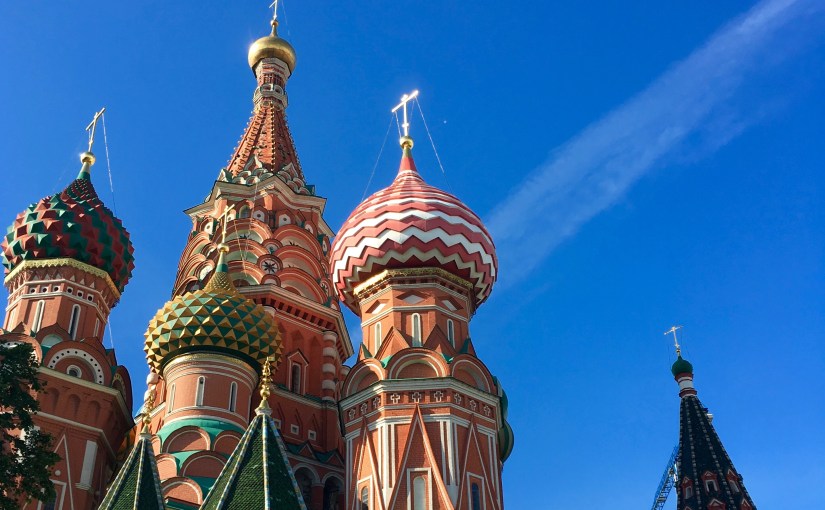
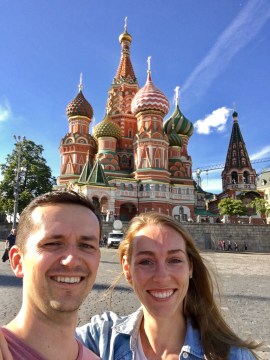
St. Basil’s Cathedral in Moscow.
The center of Red Square.
The Russian Parliament Building. I’m like 90% sure we saw Putin’s motorcade exiting…
A fabulous old food hall. It was built by Chinese merchants and has such a great turn of the century vibe.
Inside they sell coffee, tea, and other goodies.
Inside Yeliseev’s Food Hall. During Soviet times this was one of the only grocery stores that remained.
The most impressive site in Moscow, however, lies underground in the extensive and stunning metro system. Are you noticing a theme in these Soviet built cities? As with the other systems we’ve seen, the Moscow Metro stations were built bomb-shelter deep and elaborately decorated, often with a theme. My personal favorite station was chemistry themed station and dedicated to the scientist Dmitri Ivanovich Mendeleev, father of the modern day periodic table. All of the light fixtures depicted atomic structures and they were incredibly beautiful – amazing. These stations were built between the 1930s and the 2000s, and it is stunning that stations built very recently were built to be beautiful. In the US, anything built after 1970 is made out of chintzy plastic and Plexiglas (BART- I’m looking at you). Say what you will about the USSR, they made some stuff happen.
Heading down, down, down into the metro.
Such a sweet molecular light fixture!!
The stations are like soviet churches. Quite amazing.
All of the architecture is so grand.
I loved these lights too. Such excellent Soviet modern details.
To top off our adventures exploring Moscow, Olga invited us for a meal at her place with her lovely daughter Lida. Getting home cooked food is always nice when we’re traveling, and Olga is an especially good cook. We had well known Russian dishes like borscht, beef, and potatoes, but it was the more obscure Russian treats that we really loved. We had some interesting brined apples (somehow pickled without vinegar), a root-beer like drink called kvass made from rye bread, and ryazhenka, a cultured baked milk. The ryazhenka basically milk with the lactose sugars carmalized – like dulce de leche minus the dulce – and of course, was my fav thing. I will figure out how to make this at home. For desert Olga made a beautiful cake and tea – we loved it all.
Jeff and I with Lida (middle) and Olga (right). They were so gracious to us!
All of our goodies: borschtsch, brined apples, kvass, and pirozhkis.
My baked milk delight. I’m so in love.
Olga’s amazing cake.
And of course, Olga’s cat. He was a big boy.
The final highlight of our exploration in Moscow was a visit to the Kremlin Izmailovo, a strange abandoned amusement park slash flea market slash kitchsy events center. This place was w-e-i-r-d. The main sight at Kremlin Izmailovo is the is the abandoned amusement park, which is particularly creepy. It seems to have had a ‘Royalty of Old’ theme, but mysteriously no rides. I guess the kids just walked around faux castles and drawbridges and that was the fun? The front of the abandoned park has now been turned into a flea market, where vendors sell all manner of fur and matryoshka dolls painted like Putin, Lenin, and dear leader Trump.
On approach, our first thought was “What the **** is this place?!”
It got weirder and weirder inside.
This seemed to be a stage for children’s (?) performances, but sadly it was perhaps the victim of a fire at some point.
This place could easily be the setting for a good horror movie.
All of this is less weird, however, than the kitchy ‘mini-city’ next door, which inexplicably is still in use and quite buzzing. It’s basically a fever dream of an idealized pre-Soviet Russian village, replete with a faux Russian Orthodox church, a twee restaurant called ‘Grandmas Kitchen’, a kitting shop, and something called the ‘Ministry of Joy’, which evidently performs kitschy wedding services. It’s super weird to see people clamoring over one part of the Kremlin Izmailovo complex while the other side is completely abandoned. I don’t quite understand this or how it happened… but it was a good way to spend an afternoon.
This lodge ‘thing’ seemed to be the center of the action, but I’m still not sure what it is.
As suspected, antlers made an appearance.
It’s like Russian disneyland.
So much kitsch, everywhere!
We had a great time exploring Moscow city, and were getting excited to see Russia play Portugal in the Confederations Cup. Okay, maybe just one of us was excited. I’ll let you guess who… Stay tuned for soccer and St. Petersburg.
After a not-too-long train ride we arrived in Bukhara. Bukhara is on the edge of the Kyzylkum desert, and it is extremely hot and dusty. It’s also home to a pretty amazing old city from the Silk Road days. There has been a city on the site of Bukhara for about 3,000 years, but what you see today was mostly built after Genghis Khan destroyed the old city in 1220 AD. We started our tour at the Ark Fortress, where we visited a mosque and several small museums. The structures were alone were interesting, but it sounds like all of the actual treasures like gold, gems, jewelry, and elaborate decorations were ‘borrowed’ by the Soviets and now live at the Hermitage Museum in St. Petersburg. Guess we’ll see it there.
The walls of the Arc Fortress in Bukhara. This thing is definitely imposing.
The main gate entering the fortress. This tiny door is for delivering messages at night. How adorable???
The coronation room in the Arc Fortress. All coolness has been stripped away and sent to Russia. 🙂
The main mosque in the Arc Fortress. It’s got the same wooden pillar design as the mosques in Fergana.
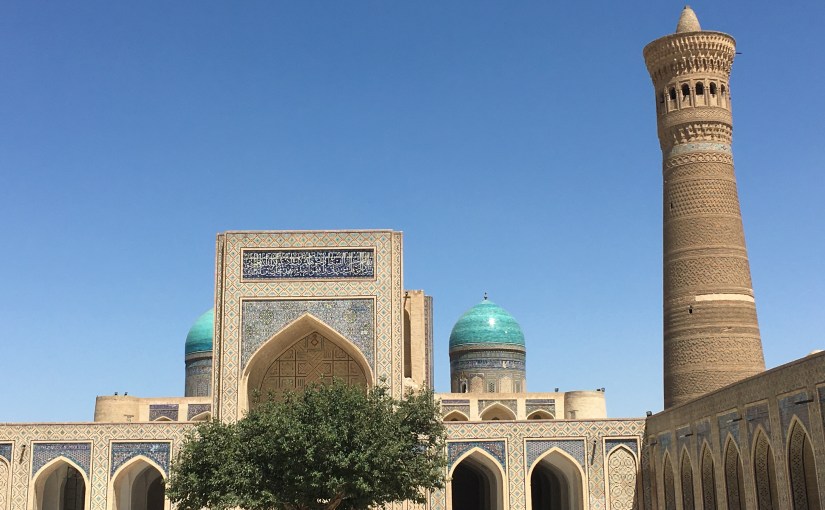
Outside of the Ark fortress, we saw the famous Mir-i-Arab Madrasah and mosque in the Po-i-Kalyan complex. Words can’t do justice to how pretty the mosque is, and the clarity of the acoustics inside the complex underscores the advanced math and physics that this culture had in the 15th century. We also explored the so-called ‘trading domes’ of the old city, which served as market places during the Silk Road’s heyday. These domes were constructed to capture cross-winds channel the fresh air downward, essentially a ‘natural air-conditioning’. Both Jeff and were shocked at how comfortable these domes felt in the 100+ F weather of Bukhara, and it made me realize that we could use a lot less energy if we just designed buildings well…
Jeff outside the Mir-i-Arab Madrasah in Bukhara.
Mir-i-Arab Madrasah at night. It was pretty magical.
The interior courtyard of the and mosque in the Po-i-Kalyan complex.
A view from the entrance to the Po-i-Kalyan complex mosque.
And further inside. I think that this was my favorite structure of the whole trip.
The arch-colonnaded prayer halls in the mosque.
Inside the prayer halls. They have empty clay vessels inside the walls to reflect back the Imam’s voice. Amazing.
The Kalyan minaret in Bukhara. It is the only structure to survive Genghis Khan’s destruction.
After two hot sweaty days of exploring the city I needed a little pampering. I headed to the Hamam Kunjak for a scrub down. This ladies-only hamam was built in the 15th century, and while the massage and scrub was homespun and a little weird (okay a lot weird) the building was fantastic. This place has an exterior courtyard with the most stunning view of the Kalon Minaret (and one of the most ‘legit’ squat toilets I’ve seen). This moment alone was worth the price of admission.
The entrance to the Hamam Kunjak in Bukhara.
An odd little maze leads to the Hamam.
But then opens into a nice atrium. The patroness insisted on taking a lot of photos of me.
But look at this view!!! It transports you back in time.
And here’s the hamam area. Not sure why this photo was necessary but it was.
Best. Floor toilet. Ever.
The following day we traveled by car to our overnight yurt camp excursion, and saw some Uzbekistan-specific road trip gems like a goat carcass hanging out of a car trunk. Yummy. We also saw some pretty cool petroglyphs that looked so similar to some of the ones in southern Utah – except for the camels. At the yurt camp we hung out at nearby Aydar lake and enjoyed chatting with some fellow travelers.
Isn’t it so annoying when your goat carcass doesn’t fit in the back seat?
Our drive to the yurt camp. So much desert.
The petroglyphs were pretty cool, though. Check out the one humped dromedary.
This guy is a two humped Bactrian camel. I guess they had both.
This is so southern Utah.
Our cozy yurt camp.
Inside was adorable and quite cozy.
They did a bonfire for us at night. You could see so many stars!!!
Enjoying some cool water at Aydar lake.
Samarkand
After an evening at the yurt camp, we continued our drive to Samarkand, likely the most famous of Uzbekistan’s Silk Road cities. There is so much to see in Samarkand, and honestly it’s a bit of a blur. We saw tons of beautiful madrasahs, the exquisite tomb of Amir Timur, Bibi Khanym Mosque, and the well preserved Shakhi Zinda Necropolis. Basically we saw lots and lots of pretty buildings. Here are some pictures.
My favorite madrasah in Registan Square – Sher-Dor Madrasah.
Jeff and me in front of the famed Registan Square in Samarkand.
Registan Square at night. This doesn’t do justice!!!
The mihrab in the tomb of Amir Timur – the national ‘hero’ of Uzbekistan.
The dome in Amir Timur’s tomb.
The mihrab inside the Tilya-Kori Madrasah.
I loved this dome!!! It has 61 ridges – the age of the Prophet Mohamed when he died.
Jeff and In in the Ulugh Beg madrassa.
Our mystery madrassa was lovely.
And had a great half dome with stalactites.
Yep, more pretty buildings.
I think that my favorite thing in Samarkand was the Observatory of Ulugh Beg, a 15th century astronomer who meticulously catagloged 994 unique stars and improved upon astrological measurements to accurately calculate the length of the sidereal year (nerd time: Ulugh Beg’s year calculations were 365 days 6 hours 10 minutes and 8 seconds, an error of just 58 seconds. Pretty impressive for 1437). The actual structure of the observatory was not preserved, but archeologists have uncovered a huge piece of Ulubeg’s sextant – the instrument used to measure distances between celestial bodies. Today you can see the sextant and a museum dedicated to science in the Arab world. It was a small but fabulous site.
Ulugh Beg’s original sextant. The light coming in would be measured along the large 60 degree arc to measure the position of the sun.
Ulugh Beg’s lab notebook. Pretty tidy.
The museum of Arabic Science at the observatory.
Some kind of cool measurement device. I’m not sure what it does but I love it.
We also visited the Afrosiab archeological park, which comprises the remains of 700 BC settlement. Researchers have uncovered an elaborate fresco wall mural depicting traders from India, China, and Korea bringing offerings of peace to the king of Afrosiab. Our favorite part, however, were these bizarre cone-head sculls in the museum. Despite numerous attempts we never got a satisfactory explanation as to what in the hell these things are, but I’m pretty sure its something concocted by the Russians in the 1930’s to justify phrenology and some kind of racist eugenics-policies against the Uzbeks. Sadly all descriptions were in Russian so I guess the world will never know.
Seriously – WFT is this???
A well preserved panel of the Afrosaib fresco.
The fresco depicts all sorts of offerings for the king.
The actual ruins are a dusty hot hill in the middle of Samarkand.
On our last day in Samarkand our guide took us for a lunch of authentic plov – the Uzbek national dish that is basically biryani (though they refuse to admit that). It was excellent and not too ‘meaty’– definitely our best meal of Uzbekistan! We then strolled through the local market, and I think our guide was taken aback by how excited we got over the dried fruit section. We really like dried fruit. Like, a lot. I bought a kilo of dried apricots stuffed with walnuts – just heaven.
Yummy plov with minimal meat!!!
We’re so happy about this.
Dried fruit heaven.
These dried apricots stuffed with walnuts (left) would cost so much at home. I may have to fly to Samarkand for all my future dried fruit needs.
They make this blackberry juice by just letting the berries ‘bleed out’ with no pressing. It’s super tasty.
This is some kind of odd egg-white and cream concoction that is only made during Ramadan. This stuff could definitely carry you through a day of fasting.
Khiva
From Samarkand we took the midnight train to Khiva – which was a real adventure. We cozied into our shabby sleeping cabin with two roomies, who woke up at the crack of dawn for a feast of hotdogs and raw onions. As you can imagine, I loved this. The best part of the sleeper train was the amazing wood-fire water boiler so that we could make our own tea and instant coffee. This thing was such a fire hazard, but I wouldn’t have survived the 12-hour train ride without it.
My favorite death trap yet. This wood-fire water heater ensured I had piping hot beverages (and slightly singed fingertips) at all times.
Getting cozy in my bunk.
Jeffy liked his bunk too.
I’m pretty sure that yellow bag contained the hotdogs and raw onions….
The exterior of our little sleeper train.
We disembarked in Khiva to find another fabulous Silk Road city with another set of beautiful buildings. The old city of Khiva is very well preserved, and the residential areas inside the ancient walls are a treat to explore. Inexplicably, one mosque in Khiva still does the call to prayer! I was delighted to hear this, even though it was the shortest and quietest call I’ve ever heard. Our guide gave us some lame explanation about how Khivans drink too much alcohol so the government allows religious encouragement here. Okay, whatever. I’m not going to get an answer for this either.
A huge and unfinished minaret. I’m standing there for scale.
Khiva is pretty darn scenic.
I love the green domes here.
More prettiness.
And more minarets.
Another colonnaded mosque. This one was really quite pretty.
Jeff in a traditional Khiva shepherd’s hat. Methinks it would be a good snow shovelin’ hat.
The entrance to a madrassa.
On our second day in Khiva (and last day in Uzbekistan) we drove out to a remote area called the ’50 Fortresses’ or something like that. There are a bunch of abandoned mud fortresses from various eras and with various functions, and we scrambled around them in the blistering heat. By this point we were beginning to feel like we’d seen every last inch of Uzbekistan. Yep, that’s a big mud fortress, some more farms, and never ending desert. Got it.
The desert was so hot.
Even this guy wasn’t having it.
We trekked up a hill to see this thing.
It was cool, but it was hot.
Another fortress.
And another.
On our last night in Uzbekistan we ate our ump-teenth plate of plov with gristle and prepared for our cruelly early (or late?) flight. Uzbekistan was a fabulous journey with some of the most beautiful sights I’ve ever seen, but after two weeks we were ready to get back to ‘normal’. At 2 am, we hunkered outside the Urgench airport with a horde of Uzbek migrant workers and awaited our flight to Moscow. Bye-bye Uzbekistan!
From Tashkent, we took a 4-hour train ride east to the city of Kokand in the Fergana Valley region of Uzbekistan. The Fergana Valley is a rich agricultural region spanning parts of Uzbekistan, Tajikistan, and Kyrgyzstan, and long-standing border disputes make the ride from Tashkent to Kokand quite circuitous. We didn’t mind, though. The trains are new and excellent, and the in-cabin entertainment system introduced us to the raucous world of Uzbek stand-up comedy. People were L-O-V-I-N-G it. Like, grown men were crying from laughter. Sadly the jokes were lost on us but it was fun to observe the hysteria.
The train from Tashkent to Kokand.
We saw lots of mountains.
And lots of dirt.
And some more mountains.
This lake was actually quite pretty.
More dirt. More mountains.
Route to Uzbek Fergana. We’re nice and close to Afghanistan!
We were met in Kokand by our Fergana guide Kamil and driver Rahim. Spending a couple of days with these guys really made Fergana Valley a highlight of our Uzbek trip. They were funny, hospitable, and willing to ‘break script’, a refreshing treat after the sterility of Tashkent. In addition to seeing the sights in Fergana Valley we came away with some insight into the economy and religious spheres of this country that we understood so little about.
Lunch in Fergana with Kamil (front) and Rahim (rear). We loved these guys!
Kokand, Fergana, and Margilan
Kokand was once a crossroad of ancient trade routes, and up until the 1880’s was the seat of a fairly large state called the Khanate of Kokand. Unfortunately the Soviets destroyed most of the interesting buildings in Kokand, but there are a few remaining vestiges. Highlights were the Khudoyar-Khan Palace, which was built by the last king of Kokand, several 18th-century madrasahs, and a nice Juma (Friday) Mosque. Many of the mosques in Uzbekistan have a very unusual architecture, with an open-sided prayer hall full of carved wooden pillars and an elaborately decorated wooden ceiling. In a desert climate like Uzbekistan, wood was a luxury product, and these mosques projected the wealth of the patrons who built them.
The approach to the Khudoyar-Khan Palace – the seat of the Khanate of Kokand.
Look at this tile work!!! I’m smitten.
The throne room inside the palace. Darling.
The prayer hall at the Kokand Juma Mosque. Its a really unusual mosque design.
The decorated wooden ceiling.
In addition to Kokand, we visited the weird-synthetic Soviet city of Fergana and the neighboring and much-more-organic city of Margilan. Evidently when the Russians tried to settle Margilan people got ‘sick’, so they built Fergana City as a creepy and sterile alternative. Fergana City is relatively unappealing has lots of really big wide streets, ‘Freedom Squares’, and a pantheon of Soviet-sized statues. By contrast, Margilan was sleepy but lived in and had some fairly lively bazaars despite it being Ramadan (more on that below).
The Uzbek Economy and Craft Production
We saw a huge array of produce at the Margilan bazaar, and it seems like half of Uzbekistan is a farm. We were surprised when Kamil told us that all of this produce is grown for the domestic market, and in fact the government prohibits the export of crops by individual farmers. In addition, all land is owned by the state and individuals can merely ‘lease’ their farms, a sure fire way to make sure no one gets too rich or powerful. Any commodities of value – things like cotton, natural gas, and gold – are state-owned, and the government has a policy of ‘import substitution’ to subsidize the manufacture of goods that would be otherwise imported. As a result of these policies, the Uzbek economy is extremely insular and any foreign investments or private business ventures are heavily dis-incentivized.
Produce at the Margilan Bazaar. Is it possible to eat this much watermelon??
Spices and other goodies.
Rice at the market. Evidently Uzbekistan grows a lot of rice, which makes no sense given the desert climate.
Various sweets and treats.
The best was this halva. Jeff and I ate a *bit* too much of this stuff. I think I have cavities now.
There is one exception to this lack of investment, however, in the area of artisan trades and handicrafts. No one wants to invest in farms or businesses that could be disrupted by the government, but a handful of successful Uzbeks have invested deeply in the knowledge and technology of various trades and traditional crafts. Pottery, weaving, carpet making, and woodcarving are huge business in Uzbekistan and we visited a number of workshops in Fergana. At first I was skeptical – we’ve seen a lot of ‘traditional workshops’ over the years, and 99% sell Chinese-made junk. Luckily, my skepticism was for naught – the Uzbek workshops were incredible. I have honestly never seen such beautiful crafts and it was exciting to meet the intelligent and creative craft-masters. Of the many excellent workshops we visited in Uzbekistan, two in Fergana Valley stand out: the Rustam Usmanov ceramic workshop in Rishtan and the Yodgorlik Silk Factory near Margilan.
The ceramic workshop in Rishtan is my heaven. The head ceramic master Rustam Usmanov worked for 10 years in the largest ceramic factory in the USSR, but after the factory closed in 1998 he started an independent venture. His workshop employs several master potters and about 10 decorative artisans who paint the pottery. Many of these artisans also have their own workshops, but they often work as a collective to pool their resources. Several years back Mr. Usmanov developed a relationship with the International Folk Art Alliance and Silk Road Collections, who together put on an annual craft show and exhibition in Santa Fe. This year 12 artists and craftspeople from Uzbekistan are selected to sell their crafts at the exhibition and this show provides a major income stream for participating workshops. I definitely plan to go next year!
Mr. Usmanov’s nephew throwing pots. He’s been throwing since he was 10.
Pottery drying before its first firing.
Look at these decorations- amazing! We sat with the guys painting for a while, and they talked us through their techniques.
The finished products. So beautiful!
A plate up-close. They’re so beautiful.
We also loved visiting the Yodgorlik Silk Factory near Fergana, which is an impressive investment in the ancient and labor-intensive technology of silk production. Uzbekistan is the birthplace of silk, and this factory is one of the most famous ikat weaving centers in the world. I can’t believe how much time goes into cleaning the silk cocoons, spinning the raw silk threads, designing the ikat pattern, dying the silk skeins with the pattern, and finally weaving the cloth. It was such a treat to see this whole process, and I would love to do a ‘craft boot-camp’ in Uzbekistan. I think if I had like 3 months I could master some of this…
Soaking the silk cocoons.
Spinning the threads of raw silk.
The skeins of raw silk are washed twice in bicarbonate prior to dying.
The dying process. This factory uses all natural dyes.
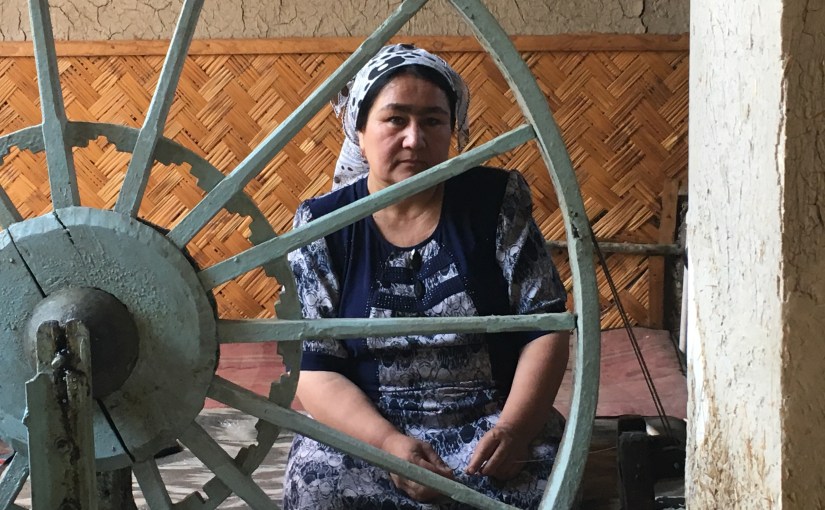
Ikat weaving. These looms are incredible!
They make silk rugs out of the lesser quality silk threads.
Look at these ladies go. It can take a year to make a rug.
They let me try my hand. Its hard…
Jeff looking like a grim Russian in his ikat outfit.
I’m a bit more thrilled about this whole process.
In case you can’t tell, these craft workshops were a major highlight for me, and I think that even Jeff thought it was ‘pretty neat’. We (okay, I) went a little nuts buying pottery and cloth, so our house will have an ‘Arabian Nights’ vibe. I can’t wait.
Islam in Uzbekistan
As we traveled between craft workshops across Fergana Valley, we had time for some interesting conversations with Kamil about religion in Uzbekistan. Before our trip, we’d read that Uzbekistan is ‘95% Sunni Muslim’ and we prepared accordingly (i.e. headscarves and a stash of snacks since it was Ramadan). Our actual experience in the country was such a divergence from our expectations.
Turns out, Uzbekistan is not really a Muslim country. At least not what I (and everyone else in the world) know as Muslim. Pork, alcohol, and dog ownership are popular. The call to prayer is banned, which is a huge bummer since I love it. Very few women wear headscarves, and those who do must abide by the ‘correct’ way of wearing a headscarf (tied behind the head, not under the chin). I was actually told not to wear a headscarf inside mosques… odd.
And Ramadan? Yeah… not really observed. One of our guides told us that she just pays charities ~12,000 SOM, or about $1.5 US, to skip a day of fasting. That means you can get out of all of Ramadan for like $45, which evidently the entire country was doing. This weirdness is due to several generations of the government restrictions on religious expression, ostensibly to combat the spread of extremism. True, the country does border Afghanistan, but these policies are just a Soviet holdover to maintain the authoritarian government’s stranglehold of power. It was very, very weird, but fascinating to see.
After a lovely couple of days exploring Fergana Valley and learning about the real Uzbekistan, it was time for us to head south and plant our feet firmly on the tourist trail again. We caught the train in Margilan and headed to Uzbekistan’s crown jewels: Bukhara, Samarkand, and Khiva.












 All Different Roads